
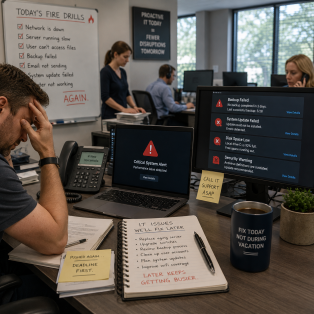
This article is part of our “The Hidden Technology Problems Slowing Down Morgantown Businesses” series, where we break down the everyday technology issues quietly affecting businesses across North Central West Virginia—and how to address them before they become bigger disruptions.
Taking a reactive approach to technology usually doesn’t feel like a problem at first. Most issues start small.
- A system slows down a little.
- A warning message pops up.
- Something feels slightly off—but still works well enough to ignore for now.
So it gets pushed aside in favor of more immediate priorities. That’s normal.
We see this all the time with businesses around Morgantown and across North Central West Virginia.
The problem is, small issues rarely stay small. And during the summer—when schedules are less predictable, people are out of the office, and teams are stretched thinner than usual—those issues tend to surface all at once. That’s what turns a normal workday into a fire drill.
The Summer Timing Problem
Summer changes how businesses operate.
- Key employees take vacations
- Schedules shift
- Teams run leaner
- Decision-makers are harder to track down
So when something breaks, even routine problems take longer to solve. We see this especially with:
- Construction companies coordinating multiple projects and crews
- Healthcare and eye care practices managing busy patient schedules with reduced staffing
- Accounting firms trying to maintain deadlines while people rotate time off
What could have been handled quietly in the background suddenly affects the entire team. And usually, the issue didn’t start that day. It started weeks - or months - earlier.
- The “It’s Just a Little Slow” System
This one almost always starts quietly. A system becomes slightly slower than usual. Nothing completely stops working, so nobody reports it.
People adjust:
- Waiting a few extra seconds
- Refreshing screens
- Restarting programs
- Working around the issue
Over time, the slowdown becomes part of the routine. Until one day it stops working altogether.
Now:
- Employees can’t access what they need
- Work starts backing up
- Everyone begins troubleshooting on their own
And if the person who normally handles these issues is out of the office? Things slow down even more. We see this happen a lot with businesses that have simply gotten used to technology friction over time. What could have been a small fix early on becomes downtime that impacts the entire business.
- The Update That Keeps Getting Delayed
There’s always an update waiting. But there’s rarely a “good time” to do it.
So it gets postponed:
- Until after a deadline
- Until after a project
- Until next week
And because everything appears to be working, it doesn’t feel urgent. Until suddenly it is.
- A system becomes incompatible.
- A vulnerability gets exposed.
- A key application stops functioning properly.
Now instead of a planned update, the business is dealing with an unexpected disruption. And during the summer, when fewer people are available, recovery usually takes longer. That’s the part most businesses don’t anticipate.
- The Backup Nobody Checked
Backups are easy to forget because when they’re working properly, they stay invisible.
Maybe there was a warning notification at some point. Maybe someone meant to check it later. But since nothing failed at the time, it felt safe to assume everything was fine.
Until something actually needs to be restored. That’s when businesses discover:
- Backups weren’t running consistently
- Files weren’t included
- Or nobody had tested whether recovery would actually work
For businesses handling sensitive information—especially:
- Accounting firms
- Healthcare practices
- Eye care offices
…that delay becomes a serious operational issue very quickly. What should have been a quick recovery turns into lost time, frustration, and downtime for the team.
Why Proactive IT Makes Such a Big Difference
The difference usually isn’t luck. It’s approach. Businesses that avoid these fire drills typically aren’t doing anything dramatic. They’re just addressing problems before they become disruptions.
That means:
- Performance issues are monitored early
- Updates happen on a schedule instead of being postponed indefinitely
- Backups are tested—not just assumed to be working
- Employees know exactly who to contact when something feels off
The goal isn’t eliminating every issue.
It’s preventing small problems from quietly turning into business-wide disruptions.
What We See Around Here
Most businesses don’t intentionally ignore these things. They’re busy. And if the issue isn’t actively hurting productivity today, it gets pushed further down the list. That’s understandable.
But around Morgantown, Fairmont, and Clarksburg, we often see the same pattern. “We meant to deal with that earlier.” The challenge is that technology problems rarely fail at convenient times.
They usually surface:
- During vacations
- Around holidays
- During busy seasons
- Or when the person who normally handles it isn’t available
That’s why reactive IT becomes so expensive over time.
The Bigger Point
Most summer fire drills don’t start in the summer. They start months earlier with:
- Small warnings
- Minor slowdowns
- Deferred maintenance
- Or issues everyone quietly adapts to
And eventually, those things demand attention all at once.
The businesses that stay ahead aren’t necessarily more technical. They just don’t let problems sit long enough to grow.
And in many cases, the systems creating these recurring problems are older technologies businesses have simply learned to work around.
👉 Link to: Old Tech Blog
Let’s Keep It Simple
If you already have a few technology issues sitting in the background right now, you’re not alone. Most businesses do.
The important thing is making sure they don’t become the next disruption that pulls your entire team off track.
If you’re a business owner in Morgantown or the surrounding area, we’re happy to help you take a practical look at what’s been piling up behind the scenes.
No overcomplication. No scare tactics. Just a straightforward conversation about:
- What’s already creating friction
- What could become a bigger issue later
- And how to stay ahead of it before it turns into a fire drill
📞 Call us at 304-296-8026 or book a quick discovery call.
And if you know another business owner around here who’s been putting off a few technology issues longer than they probably should, feel free to pass this along.
Because “we’ll fix it later” usually becomes a much bigger project eventually.
********
This article is part of our “The Hidden Technology Problems Slowing Down Morgantown Businesses” series.
If this topic sounds familiar, you may also want to read:
- School’s Out, Cybercriminals Are In
- The Longest Day of the Year and You’re Still Out of Time
- That “Old” Tech? You’re Still Paying for It Every Month
Most businesses we work with across Morgantown and North Central West Virginia are dealing with more than one of these challenges—it just shows up in different ways.
