
This article is part of our “The Hidden Technology Problems Slowing Down Morgantown Businesses” series, where we break down the everyday technology issues quietly affecting businesses across North Central West Virginia—and how to address them before they become bigger disruptions.
Every year around late June, we get the longest day of the year. More daylight. More usable hours. At least in theory, more time to get things done.
But for most business owners around Morgantown and across North Central West Virginia, it rarely feels that way.
The day still fills up just as quickly:
- Meetings run long
- Small issues pile up
- Interruptions keep pulling people off track
And before you know it, the day’s over and you’re wondering how did we run out of time again?
That’s usually the point where business owners start assuming they just need:
- More hours
- More staff
- Or more effort
But in most cases, time isn’t really the problem.
Most Days Don’t Fall Apart All at Once
Very few mornings start in chaos. Most business owners walk in with a clear plan:
- Follow up with clients
- Finish a proposal
- Focus on a project that’s been sitting too long
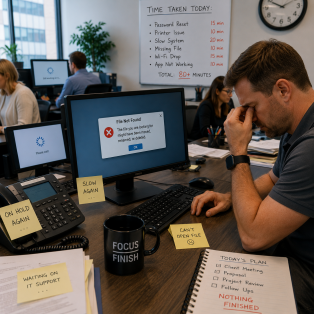
Then something small happens. Someone can’t log in. The Wi-Fi slows down. A file isn’t where it’s supposed to be. A system takes longer than it should.
None of these are major issues on their own. But each one forces someone to stop, switch focus, and deal with it. And that’s where time starts disappearing.
We see this all the time with businesses around here:
- Construction companies trying to coordinate jobs and schedules
- Healthcare and eye care practices managing patient flow
- Accounting teams juggling deadlines and client requests
Nobody loses an entire afternoon at once. They lose it:
- Five minutes here
- Ten minutes there
- One interruption after another
By the end of the day, momentum is gone.
The Real Cost Isn’t the Time. It’s the Disruption.
Most business owners don’t track these interruptions because individually they seem small. But over time, they create:
- Slower workflows
- Frustrated employees
- Delayed communication
- Constant context switching
And once focus gets broken, it takes time to rebuild it again. That’s why some days feel exhausting even when nothing major went wrong. The entire day gets spent reacting instead of moving forward.
You can feel the difference on the rare days when everything actually works the way it should.
- Systems respond quickly.
- Files are where they belong.
- People stay focused.
- Tasks move without unnecessary stops.
It doesn’t feel like you suddenly gained more time. It just feels like the business is finally working the way it’s supposed to.
A lot of those interruptions actually come from the same underlying issue: technology problems that have quietly built up over time without being addressed.
More Hours Won’t Fix a Broken Workflow
This is the part a lot of businesses miss. If your team is constantly losing time to:
- Slow systems
- Recurring problems
- Daily interruptions
- Technology friction
…adding more hours to the day won’t solve it. Neither will adding more people. Because if the underlying systems are inefficient, those inefficiencies scale with the business.
We see this a lot with growing companies around Morgantown, Fairmont, and Clarksburg. The business grows faster than the systems supporting it.
Over time:
- Workarounds become normal
- Frustration becomes routine
- And technology quietly starts controlling the pace of the day
That’s usually when owners realize that this isn’t really a time problem. It’s an operational problem.
What Actually Changes Things
The businesses that run smoothly aren’t necessarily working harder. They’ve just reduced the amount of unnecessary friction in the day.
That usually means:
- Systems are monitored proactively
- Recurring issues are fixed at the source
- Problems get caught early
- Employees have a clear process when something does go wrong
The goal isn’t perfect technology. It’s technology that stays in the background instead of becoming part of everyone’s daily workload.
What We See Around Here
Most businesses don’t think: “Our technology is slowing us down.”
Because the issues feel normal. The printer eventually works. The file eventually opens. The internet eventually comes back.
But “eventually” adds up. Especially for:
- Busy healthcare offices
- Construction teams coordinating multiple moving parts
- Accounting firms where delays create ripple effects quickly
The businesses that gain the most efficiency usually aren’t adding more tools. They’re removing friction.
The Bigger Point
The longest day of the year doesn’t help much if your systems are constantly interrupting it.
And most business owners don’t actually need:
- More hours
- More apps
- Or more complexity
They need fewer interruptions. That’s what creates the feeling of getting time back.
Let’s Keep It Simple
If your workdays constantly feel shorter than they should because technology keeps pulling people off track, it may be time to look at what’s creating that friction in the first place.
If you’re a business owner in Morgantown or the surrounding area, we’re happy to talk through it with you.
No tech speak. No hard sell.
Just a practical conversation about:
- What’s slowing things down
- What’s creating unnecessary interruptions
- And how to help your business run more smoothly day to day
Call us at 304-296-8026 or book a quick discovery call.
And if you know another business owner around here who feels like they’re constantly losing time to little technology problems, feel free to pass this along.
Because most businesses don’t need more hours in the day. They just need fewer things getting in the way of them.
********
This article is part of our “The Hidden Technology Problems Slowing Down Morgantown Businesses” series.
If this topic sounds familiar, you may also want to read:
- School’s Out, Cybercriminals Are In
- How “We’ll Fix It Later” Turns Into Summer Fire Drills
- That “Old” Tech? You’re Still Paying for It Every Month
Most businesses we work with across Morgantown and North Central West Virginia are dealing with more than one of these challenges—it just shows up in different ways.
