This article is part of our “Morgantown Business Technology Reality Check” series, where we break down the everyday technology issues we see affecting businesses across North Central West Virginia - and what they actually mean for your operations.
These 3 Scams Are Hitting Morgantown Businesses Right Now (And They’re Easy to Miss)
April 1st comes and goes. The pranks, fake announcements, and “gotcha” moments fade out quickly.
Unfortunately, the scams don’t.
In fact, this time of year is when we tend to see more of them across Morgantown and throughout North Central West Virginia—especially with how busy things get for construction teams, medical offices, and accounting firms trying to keep up with everything on their plate.
And here’s the thing: These aren’t targeting careless people.
They’re hitting good teams, doing their jobs, moving fast—the same kinds of businesses we work with every day.
As you read through these, ask yourself one honest question: Would someone on my team pause long enough to catch this?
Scam #1: The Toll Road (or Parking Fee) Text
An employee gets a text:
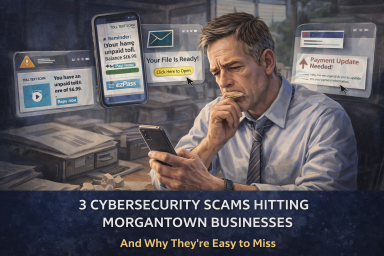
“You have an unpaid toll balance of $6.99. Pay within 12 hours to avoid late fees.”
It looks legitimate. It references something like E-ZPass. The amount is small. And if someone’s been traveling—maybe between job sites on I-79 or heading up toward Pittsburgh—it doesn’t feel out of place.
So they click. Pay. Move on.
Except… it wasn’t real.
We’ve seen versions of this hit construction teams and business owners who are constantly on the move. It works because it feels like a normal part of the day.
And $6? That doesn’t trigger alarm bells.
But behind the scenes, these scams are massive. Tens of thousands of fake domains are set up just to impersonate toll systems. It’s organized, and it’s profitable.
The simple guardrail: Legitimate toll agencies don’t demand immediate payment via text.
A good rule for any business: No payments happen through text-message links. Period.
If something might be real, go directly to the official website or app yourself. And don’t reply—not even “STOP.” That just confirms your number is active.
Convenience is the bait. Process is the defense.
Scam #2: “Your File Is Ready”
This one blends perfectly into a normal workday.
An employee gets an email saying a file has been shared:
- A DocuSign request
- A OneDrive document
- A Google Drive link
It looks exactly like every other file they receive.
So they click. Log in. Done.
Except now someone else has their credentials.
We see this a lot with accounting firms and offices handling sensitive documents—especially during busy reporting periods when files are flying back and forth all day.
And it’s getting harder to spot.
Attackers are now using real platforms like Microsoft and Google. Sometimes the email even comes from legitimate servers because the account sending it was already compromised.
So it sails right past spam filters.
The simple guardrail: If you weren’t expecting the file, don’t click the link in the email.
Instead:
- Open your browser
- Log into the platform directly
- Check if the file is actually there
If it’s real, you’ll find it. If not, you just avoided a problem.
We usually tell clients: “Take the extra 10 seconds now, or deal with the fallout later.”
Scam #3: The Email That’s Written Too Well
There was a time when phishing emails were easy to spot—bad grammar, weird formatting, obvious red flags.
That’s over. Now they’re clean, professional, and often better written than real emails.
AI is a big reason why.
These messages:
- Reference real company names
- Use actual job titles
- Mimic normal workflows
We’ve seen this hit healthcare practices, including eye care offices, where messages look like vendor requests, patient-related updates, or internal communication.
They don’t feel like scams. They feel like a normal Tuesday. And that’s why they work.
The simple guardrail:
Anything involving:
- Credentials
- Payment changes
- Sensitive information
…gets verified another way.
Call. Walk down the hall. Send a separate message.
Also:
- Hover over email addresses to check domains
- Treat urgency as a red flag, not a reason to rush
Real security doesn’t pressure you into acting fast.
What This Really Comes Down To
All of these scams rely on the same things:
- Familiarity
- Timing
- Authority
- And the idea that “this will only take a second”
That’s why this isn’t really about careless employees.
It’s about whether your processes assume people will always slow down and catch everything—even on their busiest days.
Most businesses we talk to around Morgantown feel pretty confident… until they see how realistic this stuff has become.
If one rushed click can create a real problem, that’s not a people issue. That’s a process issue. And the good news is—process issues are fixable.
That’s Where We Come In
Most business owners we work with aren’t looking to become cybersecurity experts.
They just want:
- Their systems to work
- Their team to stay productive
- And to not have to second-guess every email or message that comes through
And honestly, a lot of them come to us the same way - through someone they already trust.
As one person recently told us: “If they trust you, that’s enough for me to want to have a conversation.”
That’s how most of our relationships start.
Let’s Have a Straightforward Conversation
If you run a business in Morgantown, Fairmont, Clarksburg, or the surrounding area and want to make sure something like this doesn’t become your problem, we’re happy to have that conversation with you.
We’ll walk through:
- What businesses in Morgantown and the surrounding area are actually seeing right now
- Where issues tend to slip in during normal day-to-day work
- Practical ways to reduce risk without slowing your team down
No pressure. No scare tactics. Just a real conversation.
Call us at 304-296-8026 or book a quick discovery call.
And if this isn’t something you need right now, feel free to pass it along to another business owner around here. Because sometimes, just knowing what to look for is the difference between:
“I would’ve clicked that…”
and
“Nice try.”
This is one part of our Business Technology Reality Check series.
If this topic hits close to home, you might also want to take a look at:
- [Blog 1: Cybersecurity Scams Affecting Morgantown Businesses]
- [Blog 2: Spring Cleaning Your Business Technology]
- [Blog 3: Why Your Systems Are Slower Than You Think]
- [Blog 4: Why Your Mornings Keep Getting Derailed by Tech Issues]
Most businesses we talk to are dealing with more than one of these - it just shows up in different ways.
